A stalled sedan on Jefferson Street and a dead pickup in the I-80 truck lanes are two different jobs in the same city. The operators we dispatch need the road, the vehicle class, and the drop before anyone is assigned. Get those three facts on the call and a Joliet tow truck request can be matched to the right independent operator.
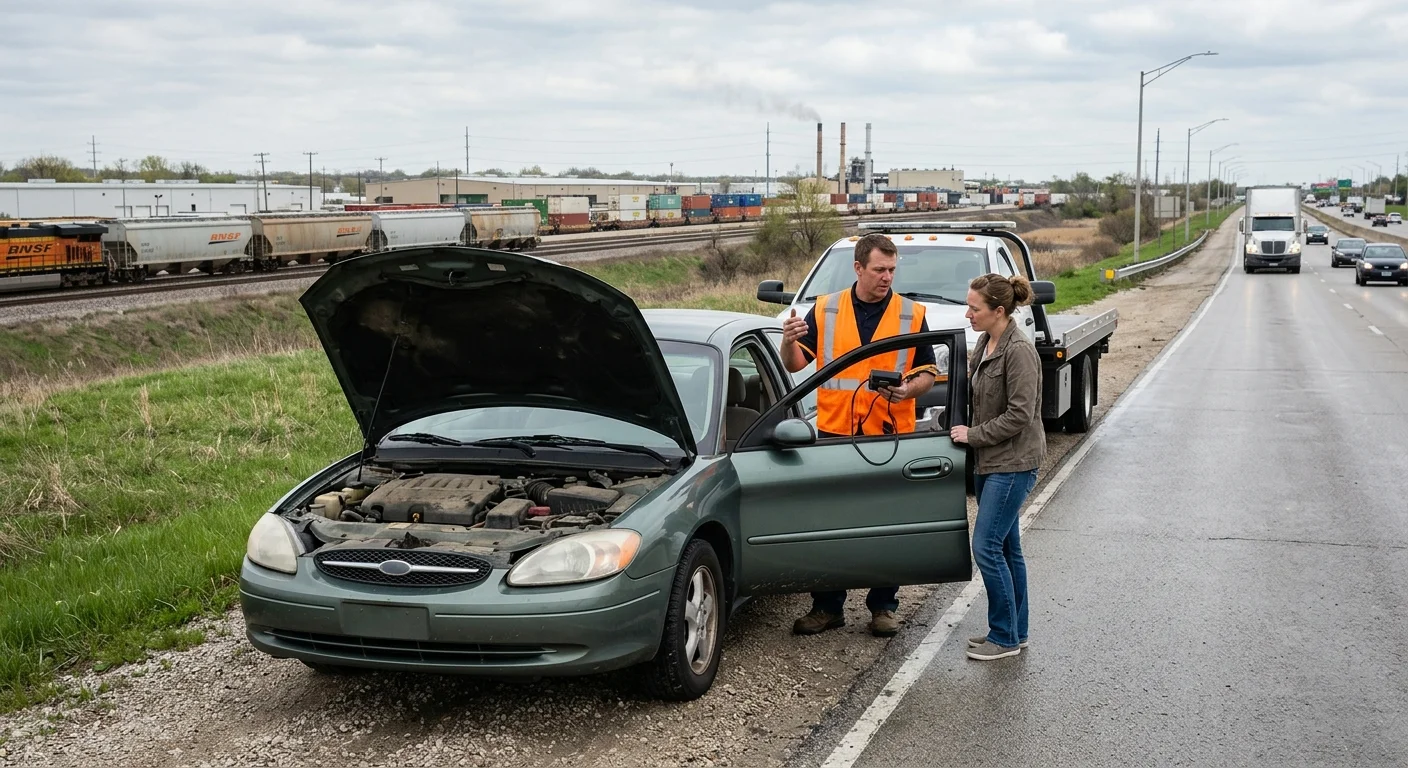
Say whether you are on I-80, I-55, or a city street
Joliet sits where I-80 meets I-55 in Will County. I-80 is the east-west freight run. I-55 is the north-south spine that carries the Stevenson south of Chicago. A call that only says you are in Joliet leaves the operator guessing which of those you meant.
If you are on I-80, say eastbound or westbound. Name the last exit you can still read on the sign: US-30, Houbolt, I-55, or US-6 if that is what it shows. If you are on I-55, say northbound or southbound. The stacked ramps at I-80 and I-55 cover a lot of pavement. “By the interchange” is too wide. Name the highway you are sitting on, the direction, and the last sign you saw.
City streets are a different map. Jefferson, Chicago Street, Cass, Larkin, and Illinois Route 53 each take a wrecker in a different way. A car in a lot off Chicago Street is a surface-street job. A car on the I-80 shoulder is a highway job. If you have rolled onto a side street in Crest Hill, Shorewood, Rockdale, or Elwood, say that town by name. Those streets sit in the same corridor, and each town still runs its own police and its own pavement.
South of downtown, the inland port is the largest inland port in North America. Terminals, rail, and truck gates sit behind that freight landscape. If you are on a public road next to a terminal, give the public road name. If you are inside a yard, say the name on the gate. Access rules for those terminals are set by each property. A single public list of gate rules could not be confirmed, so the people at the gate are the ones who decide who comes in.
Get out of live lanes when you can. Put the hazards on. If the car will not move, stay belted inside unless you are in immediate danger, then get well off the pavement. On Chicago-area expressways, IDOT’s Emergency Traffic Patrol, known as the Minutemen, may stop for a stall or a crash. They set a lane closure and warn traffic. They do not repair the vehicle and they do not tow it away. Will County logged 13,570 crashes in 2024, with 56 fatal, in IDOT’s crash facts. A precise pin on I-80, I-55, or the city street is how the operator actually finds you.
Separate a passenger car from a commercial truck
A passenger car, a cargo van, and a loaded tractor are three different assignments. This page is for the passenger car and the light truck. A Class 8 tractor, a loaded trailer, or a breakdown against the intermodal gates is the heavy job. Use the semi-truck breakdown near Joliet guide and heavy-duty towing for that work.
Say the make and model. Say sedan, SUV, minivan, or pickup. Say if it is all-wheel drive. AWD and four-wheel drive change how a wheel-lift can pick the car up. If it is an electric vehicle, say so on the call so the operator can bring a flatbed and walk you through transport mode.
Small-fleet operators around the port run a lot of cargo vans and light box trucks on US-6 and I-80. If you have a cutaway, a 16-foot box, or a one-ton with a utility body, say that. Give the GVWR from the driver’s door sticker if you can read it. Loaded or empty matters. A box with pallet freight is a different pull than the same box running empty to a shop on Jefferson.
Towing in Joliet mixes those classes on the same pavement. I-80 carries through freight. Downtown streets carry commuter cars. The operators in our network who take a Civic off Cass are often a different match than the ones who take a loaded box off a terminal road. Putting the class on the call is how that match gets made.
Quick Tow Chicago is a referral service. We take the call and match you with independent local operators. We own no trucks and we hold no Illinois Commerce Commission relocator licence. A private-property relocation in Will County is a licensed 625 ILCS 5/18a job, done by ICC relocators. If you are calling because your own car will not start, you want a requested tow. If the vehicle is already gone from a lot, that may be a relocation or a Joliet municipal impound. Each city sets its own administrative fee under 625 ILCS 5/11-208.7. Joliet’s dollar figure is not in our verified set, so confirm it with the city that took the car.
Report weight, load, and whether the vehicle rolls
The operator has to know what the truck will lift. Read the GVWR on the door sticker when you can. For a passenger car that is usually enough. For a dually, a loaded pickup, or a van with racking, say the extra weight out loud.
Say what is in the vehicle. Tools, a snowplow, a trailer still on the hitch, a car-top carrier: those change the hook. If a trailer is attached, say whether you want the trailer to go with the truck or stay put. If you do not know yet, say that too.
Whether it rolls is the next fact. Does it go into neutral. Do the wheels turn. Does the steering lock. Are the keys with you. Is it in park on a grade. After a crash, say if it sits on all four tires or if a corner is down. A car that rolls onto a bed is a simpler hook. A car that will not roll needs a winch or a slide. Once an operator is on scene, a soft-ground winch often runs fifteen to thirty minutes. A deep recovery can take one to two hours. Those are job times after arrival. We publish no arrival window, because this brand does not own the trucks.
If the car is in snow, mud, or a ditch off I-80, say which, and how far off the pavement. January around this metro averages a high of 31.6 F and a low of 18.8 F at O’Hare, with 38.4 inches of snow in a normal year. A car in a ditch on a freezing night is a recovery, and that has to be on the call.
Keys travel with you if you can take them. If they are locked in, say so. If the shifter will not move out of park, say so. Tow trucks in Joliet see all of that on I-80 shoulders and on downtown grades toward the Des Plaines River. The more of it you put on the first call, the closer the assigned truck is to the job you actually have.
Choose a shop, yard, or port-area destination
Name the drop before the operator is assigned. A shop on Jefferson, a dealer in Crest Hill, a driveway in Shorewood, a storage yard, or a port-area bay are different mileages and different after-hours problems. Give the street address. Give the name on the building. If the shop closes at a set hour, say whether someone will still take the car. We do not publish those shop hours, because they are the shop’s to set.
If you want the car at a house, confirm there is room for a wrecker to enter and leave. Alleys off the older downtown grid and tight lots near the river can be tight for a bed. Say that on the call.
Port-area drops need the same honesty as port-area pickups. A terminal may refuse an outside wrecker at the gate. If your destination is inside CenterPoint or a rail yard, confirm with that property that the truck can enter. That rule is theirs.
We serve Joliet and the other listed cities across Cook, DuPage, Kane, and Will counties. Northwest Indiana is outside that map. If the drop is a long run toward the city, tow truck near me in Chicago covers how a metro call is matched. The price is still quoted before dispatch. No dollar figure on this site is our rate. The operator sets it. The number you hear on the phone is the number on the invoice.
Keep a City of Chicago auto pound out of the drop unless the city already towed the car there. Joliet is in Will County. Chicago’s pound schedule under Municipal Code 9-92-080 applies inside Chicago. A suburban impound uses that suburb’s own administrative fee, and that fee could not be confirmed here.
What to confirm before the operator is assigned
Before an operator is assigned, run this list out loud on the call. Location: I-80, I-55, or the named city street, plus direction and the last exit or cross street. Vehicle: passenger or commercial, make, model, and GVWR if you have it. Condition: rolls or not, keys or not, loaded or empty. Drop: shop, yard, house, or port bay, with an address. A callback number that will actually ring in your pocket.
The line takes calls 24 hours a day. A notice plays, then the call is recorded and transcribed. Illinois is treated as an all-party consent state, so that notice is part of the call. There is no published email for this brand. Written contact goes through the contact page.
The price is quoted before the truck rolls. If the quote is not stated, stop and get it stated. Quick Tow Chicago does not set the rate. Independent operators in the network do.
Confirm you are asking for a requested tow, meaning you want the car moved. A police-directed tow and a private-property relocation follow other rules. Relocations in Will County are done by ICC-licensed commercial vehicle relocators. The Illinois Commerce Commission relocation towing page is the regulator’s consumer guide for that work. If a municipality impounded the car, 625 ILCS 5/11-208.7 gives the owner notice within 10 days, a right to an administrative hearing, and a first hearing no later than 45 days after the notice is mailed. If the hearing officer finds the car was stolen or hijacked when it was taken, the administrative fees already paid are refunded. The statute sets no dollar cap on the municipal fee. Joliet’s own figure could not be confirmed here, so ask the city that has the car.
For a car still with you on the shoulder, the next step is emergency towing. Have the five facts ready so the match is to the right truck.
When to call us
When the car will not roll, you are on I-80 or I-55, or you cannot get it to a shop yourself, it is time to call. The line is answered 24 hours a day. Calls are recorded after a notice, and an independent local operator is dispatched to you. Call us at (773) 830-6930.