The car is already dead. You’re on the I-88 shoulder west of Route 59, boxed in on Washington Street downtown, or sitting in a Route 59 lot, and you need it moved. Towing in Naperville starts with four facts: a pin, one sentence on what failed, the vehicle’s size, and a shop or home in DuPage or Will.
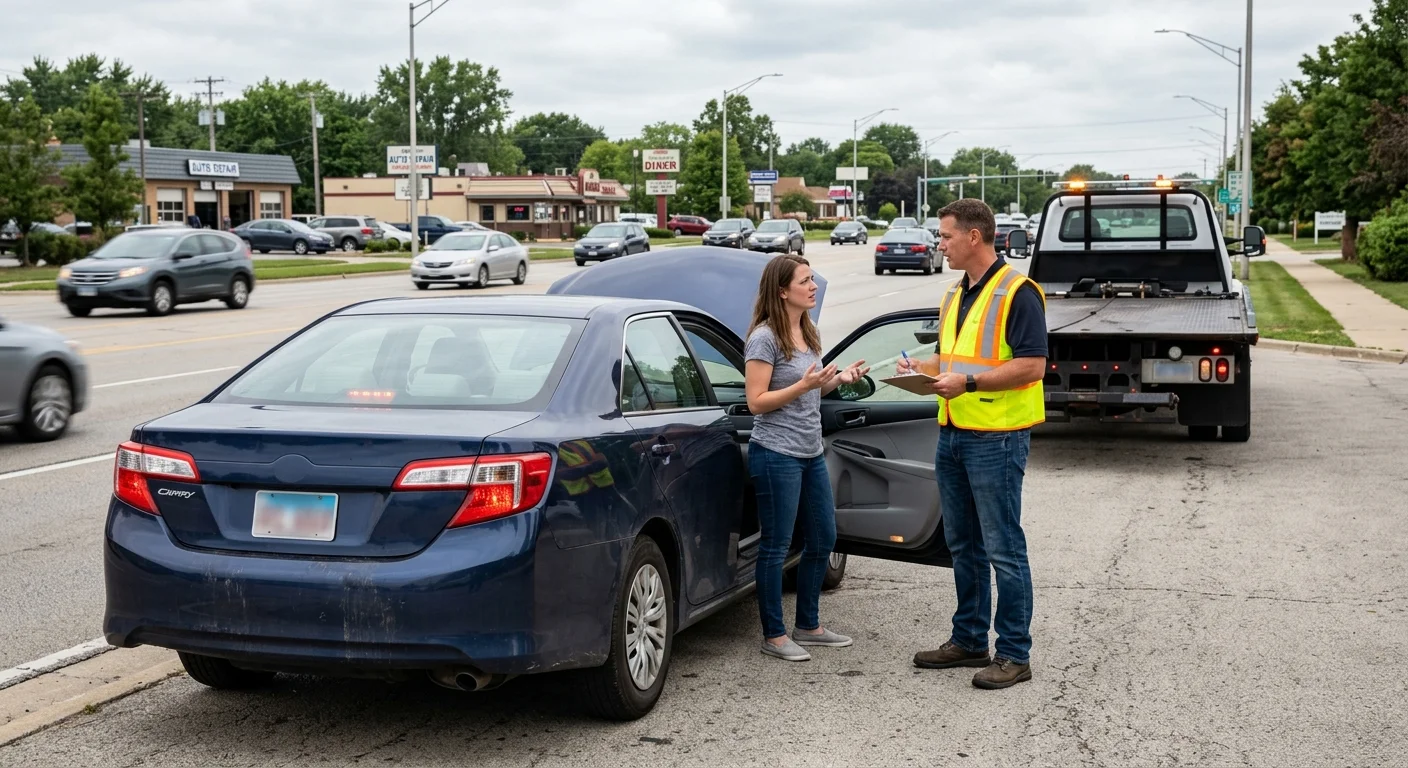
Pin down your Naperville street, lot, or highway location
Naperville is not one pin on a map. North of 75th Street you are in DuPage County. South of 75th, and especially around 95th Street, you can be in Will County. An operator rolling from Lisle is a different job than one rolling from Bolingbrook. Say the city, then the street, then the nearest cross street, then which side you are on.
Downtown is dense. Washington Street, Chicago Avenue, Main Street, and Jefferson Avenue sit on a tight grid by the Riverwalk and the Metra station. “I’m near downtown” can mean a street stall, a deck, or a private lot off the Riverwalk. Name the deck or the cross streets. A dropped pin from your phone beats a landmark every time.
The Route 59 corridor is the other common call. It runs from the I-88 interchange down past Ogden Avenue, 75th, and 95th, with big retail lots the whole way. If you are in one of those lots and the car is already gone, stop. That is no longer a dispatch for a disabled car. It is a village impound or a private-property relocation, and those follow different rules. Read Naperville private tow or village impound and start there.
Highway pins need direction and an exit. I-88, the Ronald Reagan Memorial Tollway, cuts the north end of town. Say eastbound toward Oak Brook or westbound toward Aurora. Name the nearest exit: Illinois Route 59, Naper Boulevard, or Illinois 53. If you can see a mile marker, read it. Shoulder versus gore versus a live lane matters. Get out of the travel lane if you can do it safely. Call 911 if you are still in a live lane and cannot move.
Ogden Avenue, also US-34, is the east-west commercial spine. Naper Boulevard, 75th Street, and Diehl Road near I-88 are frequent breakdown streets too. “By the hospital” is not a pin. Edward Hospital sits in a real neighborhood with real cross streets. Give those.
Private lots, village streets, and the tollway are three different places in the law. A stall on Washington is a street job. A stall in a Route 59 shopping lot is private property. A stall on I-88 is a highway shoulder. Say which one you are in. That is how the operator knows what equipment to bring, and whether anyone else may already have a claim on the car.
If you are shopping tow truck near me from a Naperville shoulder, start with that pin anyway. The phrase is generic. The job is not. Aurora to the west, Lisle to the east, Warrenville and Wheaton to the north, and Bolingbrook to the south all change who can take the run.
Say what happened to the car in one sentence
Dispatch does not need a diagnosis. It needs one clean sentence. “It will not start in the garage on Chicago Avenue.” “I hit the curb on Washington and the wheel is cocked.” “It overheated on I-88 westbound before Route 59.” “The tire blew on 75th and I cannot change it.” That sentence is enough to sort a tow from a roadside call.
A dead battery in a quiet lot may be a jump. A locked steering column, a seized transmission, or a wheel that will not turn is a tow. A crash with injuries is 911 first, then a tow once the scene is released. Do not ask a referral line to guess which shop will have the part. Say what you can see.
Keys matter. Say whether they are with you, locked in the car, or missing. Say whether it is in park, in neutral, or stuck in gear. Say whether the steering is locked. An operator loads a rolling car differently from one that will not move an inch.
If the failure is small, roadside assistance may be the right ask: a jump, a spare tire if you have one, or a lockout. If the car will not roll, or you are on I-88 and cannot work on it safely, you want emergency towing. You do not have to pick the truck type on the phone. You do have to describe the scene in that one sentence so the operator who quotes the job is quoting the right work.
Keep the sentence local. “Broke down in Naperville” is not a sentence that helps. “Disabled in the right shoulder, I-88 eastbound, before the Route 59 exit, white sedan, it will not start” is. That is Naperville towing as it actually happens, not a generic suburb swap.
If police are already on scene, say so. If traffic is stacking behind you on Route 59, say so. If you are in a gated apartment lot and the gate code is required, say that too. None of that is small talk. It is how the operator plans the approach.
Report size, drivetrain, and whether it rolls
A compact sedan on Washington, a dual-rear-wheel pickup on 95th, a Sprinter in a Route 59 lot, and a motorcycle downtown are four different setups. Say the make, the model, and a size word: car, SUV, pickup, van, box truck, motorcycle. If it is lifted, lowered, or sitting on aftermarket wheels, say that. Low ground clearance changes how it gets loaded.
Drivetrain is next. Front-wheel drive, rear-wheel drive, all-wheel drive, and four-wheel drive do not load the same way. An EV has a transport mode some operators will ask you to set. If you drive an AWD car or an EV, say it up front. Do not assume a wheel-lift is fine. Confirm the equipment in the quote before anyone is assigned.
Then the question that saves a second truck: does it roll. Can the wheels turn. Is a parking brake stuck. Is a CV axle hanging. Is the car in a stall with a concrete stop against the tires. A car that rolls can be winched onto a bed. A car that will not roll needs a different plan, and sometimes a different truck.
Quick Tow Chicago does not own wreckers or flatbeds. Independent operators in the network do. We match the job to an operator who says they have the setup you described. You still confirm that setup when you hear the quote. If the quote assumes a rolling sedan and you have a locked AWD SUV, stop and correct it before the truck is assigned.
Motorcycles, low sports cars, and work vans with racks all need an explicit note. A motorcycle on a wheel-lift is a bad idea. A lowered car on a steep bed is a bumper problem. Say it. The operator would rather hear it on the phone than at the curb on Ogden.
DuPage County logged 17,323 crashes in 2024, with 54 fatal, according to IDOT’s crash facts. Plenty of those jobs are bent wheels and cars that do not roll. If yours is a crash car, say which corners are down and whether fluids are on the pavement. Do not stand in the lane to inspect it. Describe what you can see from a safe spot.
Choose a shop or home destination in DuPage
A tow without a destination is only half a job. Name where the car should go before the operator quotes it. Home in Naperville, a dealer on Ogden, an independent shop in Lisle, a body shop in Wheaton, or a driveway in Warrenville are all real drops. Bolingbrook and Aurora are real drops too. They sit in different counties, and mileage is part of the quote.
Naperville straddles DuPage and Will. A drop north of 75th is usually DuPage. A drop around 95th can be Will. Say the shop’s street, not only its name. “The Honda place” is not an address. The operator still has to find the bay.
If you do not have a shop yet, say that. You can name a home address and sort the shop in the morning. You can also name a shop that is closed and ask the operator to drop it in the lot, if the shop allows after-hours drops. Confirm that with the shop if you can. We cannot promise a shop will take a night drop.
Longer hauls cost more because the operator is quoting time and miles, not a brand rate. We do not publish a dollar figure for towing in Naperville, and we do not set one. The operator quotes the run before dispatch. The number you hear on the phone is the number that should appear on the invoice. If the destination changes mid-call, from a Lisle shop to a house in far south Naperville, get a new quote before the truck is assigned.
People often ask if they can ride with the truck. We could not confirm a statewide Illinois rule that requires, or forbids, a passenger in the tow vehicle. Ask the operator before they roll. Have a backup ride. Downtown Naperville and the Route 59 lots are easy places to leave someone stranded if the cab policy is no.
If the car is already gone from a lot, you do not have a destination to choose. You have a lot to find. That is the village-or-private path, not this one. Use the Naperville impound post linked above, and do not wait on a dispatch pin for a car that is no longer there.
What a referral line can and cannot promise
Quick Tow Chicago is a referral service. The line takes calls any hour. A notice plays, then the call is recorded. We match you with an independent local operator. We do not own trucks, employ drivers, run a yard, or hold a towing licence. We do not perform the tow. Approved language for this brand is that we dispatch an operator, we line one up, and the operators in our network do the work.
We also do not promise an arrival time. We hold no fleet to measure one with. We do not promise a price in this article, on the site, or as a flat rate. The operator quotes before the truck is assigned. Confirm three things on that quote: the equipment, the destination, and the number. If any of those is wrong, fix it before anyone rolls.
Illinois towing is three separate regimes, and Naperville sits in two of them. A City of Chicago pound tow, with the published 9-92-080 fees, does not apply here. A suburban municipal impound is the village’s own lot and its own administrative fee under 625 ILCS 5/11-208.7. That statute requires a reasonable, cost-related fee, notice within 10 days, and a hearing scheduled no later than 45 days after the notice is mailed. It sets no dollar cap. We have not confirmed Naperville’s own administrative fee, and we will not invent one. Ask the village which lot has the car, and confirm the fee there.
A private-property relocation in DuPage is different again. In Cook, Will, Kane, DuPage, and Winnebago counties, that work is done by commercial vehicle relocators licensed by the Illinois Commerce Commission, under 625 ILCS 5/18a-300. This brand is not that relocator. If a property manager needs a relocation, we connect them with operators who hold that licence. If you are the driver and the car was taken from a lot, use the ICC’s relocation towing page for the consumer process, and use the village-or-private post to sort which regime you are in.
Predatory patterns show up when someone skips the quote, adds charges after the hook is on, or treats a private-lot grab like a street tow. For a job you are hiring, the clean test is simple. You get the price before anyone is dispatched. You confirm the truck type. You confirm the drop. For a job you did not hire, the ICC and the village are the authorities, not a referral line.
Tow truck Naperville IL searches are full of arrival promises and invented rates. Ignore those. A useful call for towing Naperville IL is the one where you already have the pin, the one-line failure, the size, and the destination. That is what dispatch needs. That is what the operator can quote.
When to call us
If the car will not move under its own power, or you are on I-88 or Route 59 and cannot work on it safely, this is past a jumper-cable favor. The line takes calls 24 hours a day. Calls are recorded after a notice. We dispatch an independent local operator once you confirm the quote, the equipment, and the destination. Call us at (773) 830-6930.