Your car is missing from a Melrose Park curb, an apartment stall, or a plaza off Lake Street. The next move depends on which of three rules took it: a village street impound, an Illinois Commerce Commission relocator, or a breakdown tow someone actually called. Mix those up and you will pay the wrong office and still not have the keys.
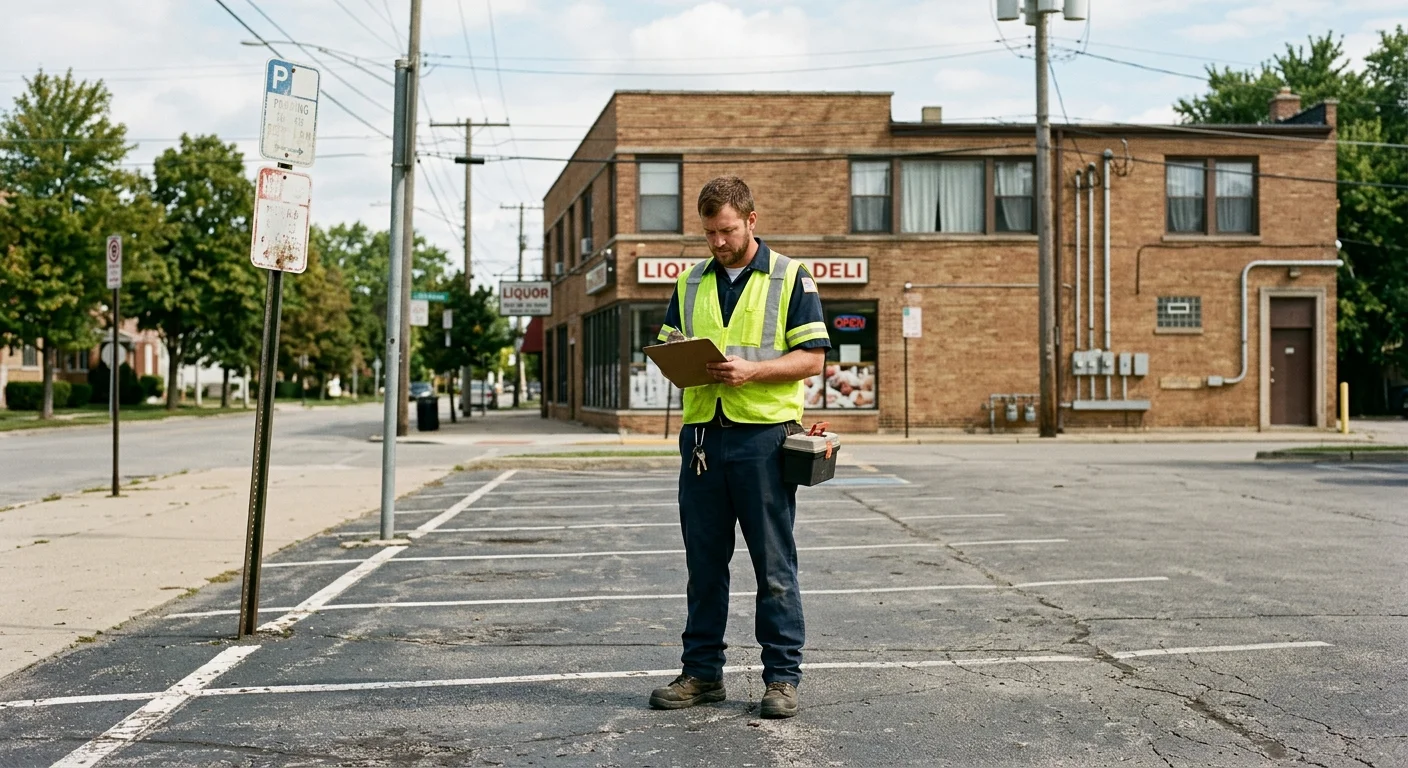
Start with where the car was parked in Melrose Park
Melrose Park sits in west Cook County between Maywood, Bellwood, Northlake, Stone Park, and Franklin Park. Mannheim Road (U.S. 12/45) and North Avenue (Illinois 64) cut through it. Lake Street (Illinois 20) still carries the older commercial strip. The Eisenhower (I-290) runs just south through Maywood. The Tri-State (I-294) sits west toward O’Hare. Factories along the rail corridor, apartments, strip plazas, and side streets share the same few square miles. That is why towing Melrose Park is not one process.
Start with the pavement under the tires.
If the car was on a public village street, a posted no-parking stretch, or a snow route the village actually enforces, you are probably in a municipal impound. The Village of Melrose Park runs that process. It is not the City of Chicago pound system. Chicago’s four auto pounds and the 9-92-080 fee schedule apply only inside city limits.
If the car was in an apartment lot, a Winston Plaza stall, a factory lot along the tracks, a Gottlieb visitor space, or a store lot with a posted relocator sign, that is usually private property towing. In Cook County those jobs are done by commercial vehicle relocators licensed by the Illinois Commerce Commission under 625 ILCS 5/18a.
If you broke down on Mannheim, North Avenue, 25th Avenue, or the I-290 shoulder, and you or a passenger called for a truck, that is a third path: a consented emergency tow. The operator you asked for has the car. That is not an impound and it is not a relocation.
The city line matters. Melrose Park’s east edge sits against Chicago neighborhoods like Galewood and Austin. A block can look the same and sit under a different government. If you parked on the Chicago side, use the city’s find-your-vehicle tool and treat it as a city tow. If you parked in the village, that tool will not help.
A car left in Park with the brake set can still be moved. A wheel-lift or a flatbed does not need the transmission in Neutral. “It was in Park” does not tell you who took it. It only tells you the truck had a way to lift the wheels.
Village street tows follow a municipal process
A village street tow in Melrose Park is a suburban municipal impound. Illinois sets the procedure in 625 ILCS 5/11-208.7. The village still sets its own administrative fee.
The statute says that fee must be “reasonable” and “related to its administrative and processing costs.” It sets no dollar cap. We could not confirm Melrose Park’s current administrative fee, daily storage rate, lot address, public hours, or release forms from a published village schedule in our claims file. Do not assume Chicago’s $250 tow under 8,000 pounds, $350 at or above, or $50 / $100 daily storage. Those figures are the city’s, cited to Municipal Code 9-92-080. A Melrose Park impound is a different government. Ask the Village of Melrose Park for today’s charges before you pay.
State law does give you process. The owner is entitled to notice within 10 days of impoundment. An initial administrative hearing must be scheduled and convened no later than 45 days after the date of the mailing of the notice. You have the right to that hearing. If the hearing officer finds the vehicle was stolen or hijacked when it was impounded, the municipality must refund administrative fees already paid.
None of that is a Chicago pound clock. Chicago stores vehicles no less than 21 days from the date the city mails notice, with one 15-day extension under 9-92-100(a). That clock is for city pounds. Do not apply it to a village lot in Melrose Park.
People searching “melrose park impound” usually mean this path. Work with the Village of Melrose Park or village police through the contacts on the village’s own site. Ask whether they have the plate, which lot holds it, what documents they want, and what they charge today. Bring photo ID and proof of ownership. Ask for an itemized list of charges.
A referral service cannot pull a car from a village impound. Quick Tow Chicago does not run a yard and does not hold a village contract. If the village has it, you work with the village until they release it to the owner.
There is also no published “minimum cost for a tow” that covers this village. Our own operators quote before dispatch on jobs we can send. A municipal fee is whatever the village has set, and that number is not in our ledger.
Apartment and shopping-lot tows follow a private relocator
Apartment and shopping-lot tows in Melrose Park are usually relocations, not village impounds. Cook County is one of the counties where 625 ILCS 5/18a requires an Illinois Commerce Commission licensed commercial vehicle relocator. The law does not apply to public-street tows, disabled-vehicle tows you asked for, repossessions, or police-directed tows.
Walk the lot before you pay anyone. Illinois sign rules under 18a-302 are specific. Where signs are required, they must be at least 24 inches high by 36 inches wide, at least 4 feet off the ground and less than 8, and illuminated or painted with reflective paint, or both. They must carry the relocator’s name, address, and telephone number, and the towing charges a parker may face. Residential property clearly reserved for residents has a narrower notice rule. Photograph the signs. The name on the sign is the company that should have the car.
A few practices are unlawful under 18a-300. Advertising without the relocator’s license number. Removal without written authorization from the property owner, the person in lawful control, an authorized agent, or an authorized law enforcement officer. Removal when the owner or operator is present, willing, and able to move the vehicle immediately, with a narrow CDL-vehicle exception. Removal from property that needs signs when those signs are missing. Failing to notify local law enforcement within one hour of the removal. Hauling farther than 10 air miles from the lot, or 15 from an unincorporated location. Charging outside Commission-set rates.
The current ICC maximum relocation rate is not published on the Commission pages we read. Treat any number you hear as something to check against the invoice and the ICC relocation towing page. Do not treat a figure from a forum as the legal cap.
Storage rules are clearer. No storage charge after you claim the vehicle, show proper identification, and tender payment. No storage for hours or days the relocator is closed to the public. No storage fee at all if you claim the vehicle within 24 hours with ID and payment. Relocators must accept cash, money orders, cashier’s or certified checks, and major credit cards without extra fees. You should receive a complete Relocation Towing Invoice as a receipt, with complaint instructions on it.
There is also a one-hour phone rule. If, after a reasonable effort, you cannot reach the relocator by phone for an hour during a period they must answer, all fees for towing, storage, or otherwise are waived. Keep a call log with times.
Complaints go to the Illinois Commerce Commission in Des Plaines through the relocation-towing page linked above. Use the invoice. Do not pay a second company that does not have the car.
Quick Tow Chicago is a referral service. It is not an ICC relocator. We do not relocate cars off private lots. Property managers who need that work get connected with relocators who hold the license.
Confirm who has the car before you pay or drive
Do not drive to 701 N Sacramento or 103rd and Doty because a Chicago friend told you to. Those are city pounds. A Melrose Park village tow and a private relocator will not be there.
Work the scene in this order.
First, confirm the geography. Are you in the village, in Stone Park, in Northlake, or over the Chicago line. A wrong town sends you to the wrong desk.
Second, read every sign in the stall and at the driveway. A relocator sign with a company name is your first lead for who towed my car Melrose Park. If there is no relocator sign and you were on a public street, start with the Village of Melrose Park.
Third, check with the building office, the shop manager, or a neighbor who watched the truck. Ask for the company name on the door, not a nickname.
Fourth, match the paperwork to the regime. A village notice points to a municipal impound and the 11-208.7 hearing clock. A Relocation Towing Invoice points to an ICC relocator. A quote you approved on the phone points to a breakdown tow.
Fifth, do not pay until the name on the invoice matches the name that actually has the car. Storage can accrue at a relocator after 24 hours. Village storage is the village’s own rate, which we could not confirm. Paying a Chicago pound, or paying a shop that does not have the vehicle, does not release it.
The so-called 80 percent rule that shows up next to this search is not an Illinois relocator rule we could confirm, and it is not a Melrose Park village tow rule. Illinois salvage law uses different tests, including a 50 percent of fair market value threshold in several total-loss situations under 625 ILCS 5/3-117.1. That is a title problem after a wreck, not a lot-release formula. Ignore it on a missing-car night.
If you still cannot find the car, treat theft as possible. Inside Chicago, the city tells you to check the lookup tool and use its non-emergency request line before you report the car stolen. In Melrose Park, use the village police process on the village’s own site. Do not skip that step because a tow feels more likely.
Naperville drivers face the same three-regime split on a different map. If you want that west-suburb pattern spelled out for a DuPage city, read private tow or village impound in Naperville. For a city-pound walkthrough, start with who towed my car in Chicago.
What a referral line can do after the car is already gone
Once the car is already gone, a referral line has a narrow job.
If the village impounded it, we cannot release it. We cannot quote the village’s fee. We cannot send an operator to a municipal lot to pick it up for you as if it were a private yard. That is village property until they release it to the owner.
If an ICC relocator has it, the invoice, the signs, and the Commission rules control the release. We can help you sort which regime you are in. We cannot waive a relocator’s charges or pretend to be the licensed company on the truck.
If the car is still on the street, in a lot you control, or disabled on Mannheim, North Avenue, or the Eisenhower shoulder, that is the work we refer. You call, you hear the recording notice, and the line takes the request 24 hours a day. The price is quoted before an independent local operator is dispatched. The number you hear is the number on the invoice. We own no trucks and we run no storage lot.
IDOT’s Emergency Traffic Patrol, the Minutemen, may already be on I-290 if a stall is blocking a lane. They protect the scene. They do not tow the car away. You still need an operator if the vehicle has to leave.
If you are the property manager, not the driver, and you need a car moved off a Melrose Park lot, that is relocator work under 18a. We connect you with operators who hold that license. We do not hang signs or haul from the stall ourselves.
A dead battery, a lockout, or a car that will not move under its own power is still a consented roadside job, even after a confusing night. Say where you are standing. Lake Street, 25th Avenue, North Avenue, and Mannheim are not interchangeable for the operator who has to find you.
When to call us
Call when the car is still yours to move: a breakdown, a crash, a stall on Mannheim or I-290, or a vehicle you have the right to have towed from a lot you control. If the village already has it, you work with the village. The line takes calls 24 hours a day. Calls are recorded after a notice plays. An independent local operator is dispatched once you approve the quote. Call us at (773) 830-6930.