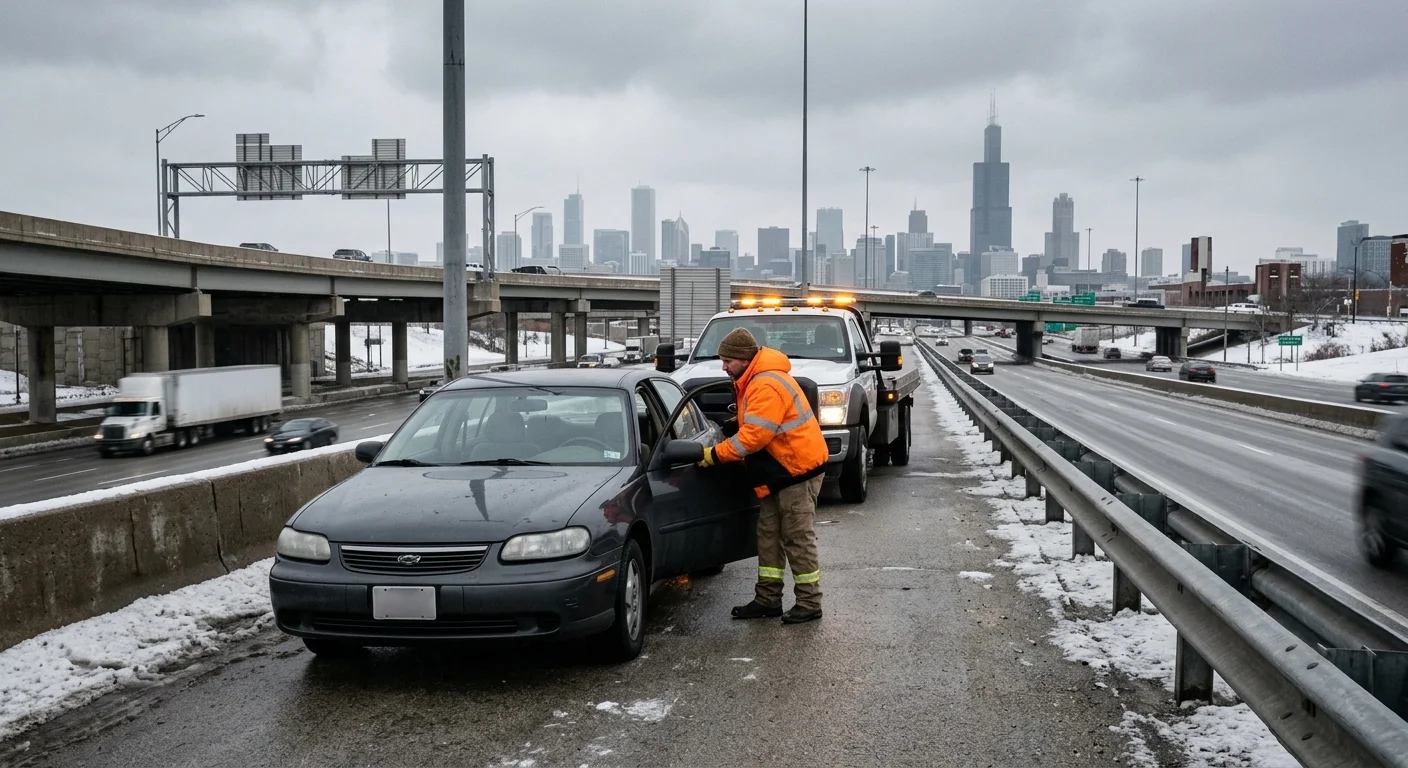
The wheels lock on black ice and the car is stuck on a Chicago overpass with traffic still moving. That is a stay-or-tow call, not a restart-and-hope one. Your first job is to stay alive. The car comes second.
Get out of traffic before you worry about the car
If you came to rest in a live lane, treat it as an emergency. Call 911. Say you are stopped on ice on an overpass. Name the expressway and the direction. Stay in the vehicle with the doors locked unless a first responder tells you otherwise. Do not walk the deck. Do not cross live lanes. Do not climb a parapet to reach a side street.
An overpass has no ditch and no tree line. The wall is the edge. If you already made the shoulder or a gore, leave the hazards on and stay with the car. A dark coat on ice at night is how a second crash starts. The car’s lights are the thing other drivers can see.
IDOT’s Emergency Traffic Patrol works Chicago-area expressways. Those crews are also called Minutemen. They set up emergency lane closures, warn approaching traffic, and protect the people already on scene. They do not repair vehicles and they do not tow them away. If a patrol unit is with you, follow what they say about remaining in the car. Recovery waits until they allow access.
Cook County logged 164,559 crashes in 2024, about 54 percent of every crash in Illinois. Ice on an elevated deck is a common winter setup for those pileups. You do not need to add yours. If anyone is hurt, stay on the line with 911. If the car is smoking, leaking fuel, or taking hits from passing traffic, say that in the first sentence. First responders own the scene until they release it.
This is not the moment to pop the hood, dig for a floor mat, or argue with the next driver about who slid first. Get the human risk out of the travel lanes. That means 911 if you are still in one, hazards on if you are already clear, and no walking on the ice.
Describe the overpass, ramp, or shoulder you are on
Dispatch cannot guess which span you are on. “I’m on the Kennedy” is a start. “Inbound Kennedy, over the Chicago River, right lane against the wall” is a location an operator can work.
Name the road. Kennedy, Dan Ryan, Eisenhower, Stevenson, Edens, Bishop Ford, Tri-State, I-57, I-80, I-88, the Skyway, DuSable Lake Shore Drive. Name the direction: inbound toward the Loop, outbound, northbound, southbound. Name the span if you can see it: over the river, over the tracks, over Roosevelt, the ramp into the Jane Byrne Interchange, the Hubbard Cave, the collector at Pulaski on the Ike. Say where the car sits: live lane, shoulder, gore, ramp, or the wall. Say the grade: uphill, downhill, or cambered toward the barrier. Say what the ice looks like: clear black ice, packed snow over ice, or slush on a frozen deck.
A stall on the Kennedy or the Dan Ryan is a different job from a slide on a Naperville ramp or a collector on I-88. City streets, IDOT expressways, and a village ramp are three access problems. If you can read a door on a unit already there, name that department. If you cannot, do not guess.
A pin drop helps. A mile marker helps. “Just west of the Circle” helps. “Dan Ryan at 63rd, southbound, left shoulder” helps. A photo of the ice and the car’s angle helps an operator pick a flatbed versus a winch setup. Do not step into a lane to take it.
If you are on a city arterial that passes over an expressway, say that. A span over the Kennedy at Division is not the same as being on the Kennedy. Access for a wrecker can be from the lower level, the upper deck, or a side street. That is the difference between a simple hookup and a blocked recovery. Same rule on Lake Shore Drive overpasses and the ramps that dump into the Loop from I-90/94. Height, grade, and which deck you are on all change the truck that can reach you.
When to wait for recovery instead of trying to drive
If the tires spin and the car will not track, stop. More throttle polishes the ice. You drift toward the wall or back into a lane.
Wait for recovery when you are on a grade and the car will not hold. Wait when a tire is over the shoulder line or against the barrier. Wait when you already hit the wall, a gore, or another vehicle. Wait when all-wheel drive is still spinning. Wait when you cannot see the ice but the car will not bite. Wait when a first responder has told you to stay put.
Do not rock it out on a bridge. That is a parking-lot move. On a deck it is how you enter a travel lane. Do not follow a stranger’s “just give it gas” from the next car. They will not be the ones on the ice with a wrecker.
This is not the same job as a car stuck in snow. Snow can give a winch a bite. Black ice is a friction problem. The operator we send may still winch, but they will treat the surface as a slide, not a drift. If you already tagged the barrier, accident recovery is the right bucket.
NWS Chicago climate normals at O’Hare put the January average high at 31.6F and the average low at 18.8F. The city sees 121.3 nights a year at or below 32F, and 6.5 nights at or below 0F, with 38.4 inches of snow in a normal year. Overpasses lose heat from the deck and from underneath. The span can ice when the street below still looks wet. That is why a clear night after a melt is when these slides show up on the Skyway, the Circle, the Jane Byrne ramps, and the Edens over the North Branch.
If the car would be driveable on dry pavement once it is off the ice, say so when you call. That still does not mean you should keep trying on the deck. The operator quotes a price before the truck rolls. You do not get that number from a blog, and you do not get it by guessing from a snow winch-out.
Leave the mats in the trunk. Leave the kitty litter in the trunk. Those tricks belong in a lot, not on an expressway overpass with traffic at your bumper.
What dispatch needs about ice, grade, and access
When you call the line, you hear a greeting and a recording notice first. Illinois is treated as an all-party consent state, so that notice is not optional. The line takes calls 24 hours a day. Leave the facts. An independent local operator gets the job once access is allowed.
Say the exact location, in the same order you would tell 911. Say the vehicle: make, model, color, plate state. Say the drive type: front-wheel, rear-wheel, all-wheel, or four-wheel. Say how many people are in the car, whether anyone is hurt, and whether 911 is already involved. Describe the ice and the grade. Say whether a lane is blocked. Say whether IDOT, Chicago Police, or another unit is already there. Say whether you have the keys, whether the steering is locked, and whether the car is in park, in gear, or in neutral. Say where you want the car to go once it is free.
If access is blocked, say that. A wrecker cannot climb a closed ramp. A Minuteman closure may have to open a path first. Quick Tow Chicago is a referral service. We own no trucks and we run no yard. We line up an operator. We refer recovery once someone on scene allows the truck in. That is the whole job.
If the car is an EV, say so. Transport mode and a flatbed matter on ice the same way they matter on dry pavement. If it is a low sports car, a work van with a rack, or a truck over 8,000 pounds, say so. Weight changes how the city would treat an impound later. It also changes which operator can take the hookup.
Do not attach straps. Do not crawl under the car. Do not stand downhill of a vehicle on ice while someone else pulls. That is the operator’s work once the scene is theirs. A deep recovery, once they are on scene, can take one to two hours. Ice, grade, and a live expressway all stretch that.
Our price is quoted before dispatch. The number you hear on the phone is the number on the invoice. City pound fees are a different world. If the car later goes to a City of Chicago auto pound under Municipal Code 9-92-080, the city publishes $250 to tow a vehicle under 8,000 pounds and $350 at 8,000 pounds or more, plus $50 or $100 a day in storage, cash or major card only. Confirm the current figures on the city’s Common Towing Questions page. That schedule is not our price, and it is not what a suburban village charges.
Confirm a destination once the scene is safe
Once first responders say the scene can be cleared, pick a destination before the car is loaded. A driveway in Gage Park, a shop on Pulaski, a lot in Cicero, a house in Oak Lawn, a garage in Elgin. Say the address. If you do not have a place, say that. Do not ask us to store it. We run no lot.
If the car is not driveable, a shop with indoor space beats a curb overnight. From December 1 through April 1 the city enforces the winter overnight parking ban on 107 miles of arterial, 3am to 7am, snow or no snow. A dead car left on those miles can become a ticket-and-tow problem. That is not this overpass job. It is why you should not dump a recovered car on Western, Ashland, or Cicero Avenue and walk away.
If the car was moved by the city rather than recovered for you, that may be a relocation, not a private tow. The city’s own instruction is to check the vehicle lookup and contact the city’s non-emergency line before you report it stolen. Do not mix that process with a winch-out on the Dan Ryan. They are different regimes.
Tell the operator if you need the car taken off the expressway only, or taken all the way home. A drop on the first dry side street can put you back on black ice two blocks later. A drop in a well-lit lot in Pilsen, Little Village, or near a shop you already use is cleaner. Confirm that destination out loud. Do not assume the truck is going where you think it is going.
If the car will start and steer once it is off the ice, you can still choose a tow. That is your call after you hear the quote. If it will not start, or the wheel is bent against the wall, the choice is already made.
When to call us
If the car will not hold on the ice, or you already hit the wall, this is no longer a restart. Call us at (773) 830-6930. The line is answered 24 hours a day. Calls are recorded after a notice. We dispatch an independent local operator for emergency towing once access is allowed on the scene.